
Auto-translated from Spanish
Today we’re going to talk about a topic that, to me, is one of the most advanced and “tricky” to grasp when doing SEO for your website, a client’s, or a friend’s: search intent.

First, let’s define exactly what search intent means in SEO. As the term itself suggests, it’s the intent a user has when typing a search into Google, and in turn, what kind of content they’d expect to find.
Let me explain it more simply with an example: say you want to buy a new monitor for your desk or office through Google. When you type the keyword “desk monitor” into the search bar, you’ll get certain results ranked over others — and let’s be honest, you’ll probably click on the first or, at most, the second result. Once you land on that first page, you find a wide catalog of monitors, complete with prices, reviews, and use cases — exactly what you’re interested in.
Now, what happens if, after clicking that first result for the same search “desk monitor”, you land on a super long article about the history of desk monitors — what they’re made of and how they’ve evolved over time? In that case, you’d probably lose interest fast, because that content doesn’t match your intent, which in this example was to buy a monitor.
As SEOs, we need to understand exactly what search intent a given keyword carries, since that gives us the key signals our URL should have in order to rank in search. But… how do you actually figure out the search intent? Let me show you:
How do I find out the search intent of a keyword?
This is where things get a bit tricky, or interesting, since you need to understand what’s behind each keyword. For this step, I really recommend already having your keyword research done ahead of time, so you can classify and understand your keywords based on what I’m about to explain.
The first and only step: search the keyword on Google!
Yep, bet you weren’t expecting that first step, haha. Basically, the first and most important thing is to search that keyword on Google. This lets you see and understand which results Google is prioritizing over others, which is hugely relevant for understanding user intent.
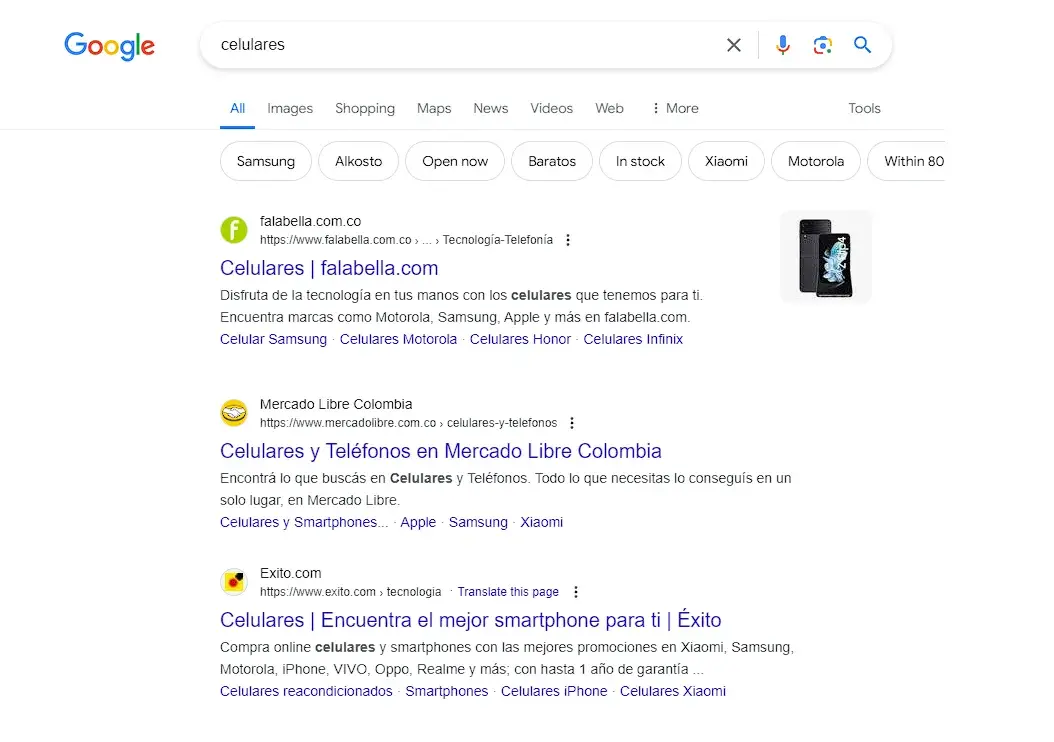
As you can see in the screenshot above, in this example I’m interested in ranking organically for the keyword “cell phones”, and to do that, I need to understand its search intent. The first thing I recommend is browsing through the first 3 results and checking out what kind of content these pages generally offer. In this case, I’ll focus only on the first result, Falabella, a big marketplace here in Colombia.
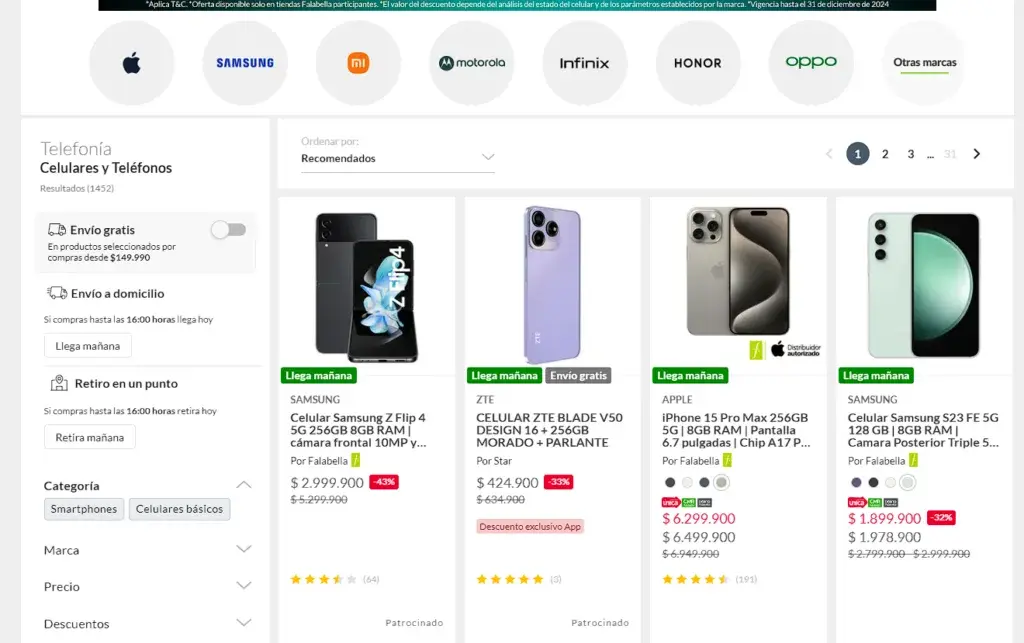
As we can see, this has a very e-commerce-style structure, with a product listing, filters, and main categories. In conclusion, the content is aimed at satisfying a need or intent to buy a cell phone.
And I want you to hold onto that “buy” part. Once you’ve done this analysis, it’s a good idea to check the content of the other ranking positions too, and see whether more of it leans toward buying, or maybe leans a bit more informational (I’ll get to that classification next).
Once you’ve identified this initial search intent, you’ll have a much clearer picture of what to do, or what type of content your page needs to rank in those top search results.
And yes, that’s really it! Just by typing in the keyword and looking at the content, you can determine the intent behind that search. IMPORTANT: the more results you see of one type, the more you can reinforce (or rule out) that conclusion. But… what do I mean by “types”?
Types of search intent
Every keyword can fall into one of the following 2 search intents I’m about to give you. Though SPOILER, there’s also a third type.
Transactional
As we saw in the previous example, if the results for a keyword are geared toward buying something, we’re talking about a transactional keyword — focused on converting, generating revenue, and satisfying a user’s intent to purchase. Once you know the type, you’ll know what kind of content to provide. In this case, skip the informational stuff — the user wants to buy, so give them the options to do it.
Informational
An informational keyword is one whose results are meant to inform users. Examples of this: what should a gaming monitor have? or what are the most important features of a mid-range phone? These keywords are focused on informing and satisfying an informational search intent. For this type of content, a blog-style article that covers all the info usually works best.
Mixed
Life is never black and white, it’s made up of shades of gray, and this case is no different. If you see that a keyword’s top results include both transactional and informational pages, that means it’s a mixed keyword — in other words, users are looking to inform themselves, to buy, or both. For this type of keyword, I’d suggest working with a mostly transactional format, adding relevant information through an FAQ section or paragraph-style content.
Conclusion
Understanding a keyword’s search intent doesn’t just help you figure out what content you need to optimize to rank at the top — it also determines the type of content or strategy you should follow to get better results.
Invest a good amount of your time understanding this intent, since it’ll help you achieve better organic results by presenting the content users want to see at exactly the right moment.