Auto-translated from Spanish
Introduction
SEO (Search Engine Optimization) is the digital marketing discipline that optimizes web pages so they show up among the first results of search engines organically. Its main goal is to attract quality traffic without paying for every click.
Hi! I’m José. In my more than 5 years of experience working hard on search engine rankings, I’ve seen how SEO completely transforms businesses. If you’re reading this, relax: it’s not because of some ancestral force or pure chance. You got to this beautiful article thanks to SEO.
In this complete guide I’m going to explain, in a very simple and straightforward way, how search engines work, which technical aspects you need to take care of, how to create content that truly answers what users are searching for, and how to prepare for the new optimization strategies for artificial intelligence (GEO).
To really understand this, we first need to see how this concept shows up on your screen when you run an everyday search.
Defining search engine optimization
SEO stands for Search Engine Optimization. In practice, SEO is one of the many branches of digital marketing in charge of applying different techniques to optimize and improve your website’s content. The result? That it shows up, almost by inertia, among the first search results, which means more visits, more sales, more leads or whatever the KPI of your business or company is. If you want the official version, Google has its own SEO starter guide.
At the beginning I opened this article with an important note: if you’re here, it’s because this URL or page you’re reading right now landed on your radar. This usually happens for three main reasons:
- Classic SEO: You were on Google, ran a search and found this result among the first ones in the great universe of the internet (this is where we’re going to focus today).
- Social media: I shared it on one of my networks and you came to understand more.
- GEO (Generative Engine Optimization): You found this web article as a suggestion recommended by a language model (LLM) like ChatGPT, Gemini or Claude.
Like I was saying, this URL was carefully optimized so that when you searched “what is seo” on Google, you’d find me! Don’t you think that’s really cool? To me it’s simply spectacular.
To give you a visual idea, imagine someone searching for “food delivery” on Google. The results on screen are organized in different positions. The higher a website sits in that ranking, the more relevant and useful it is for the user.
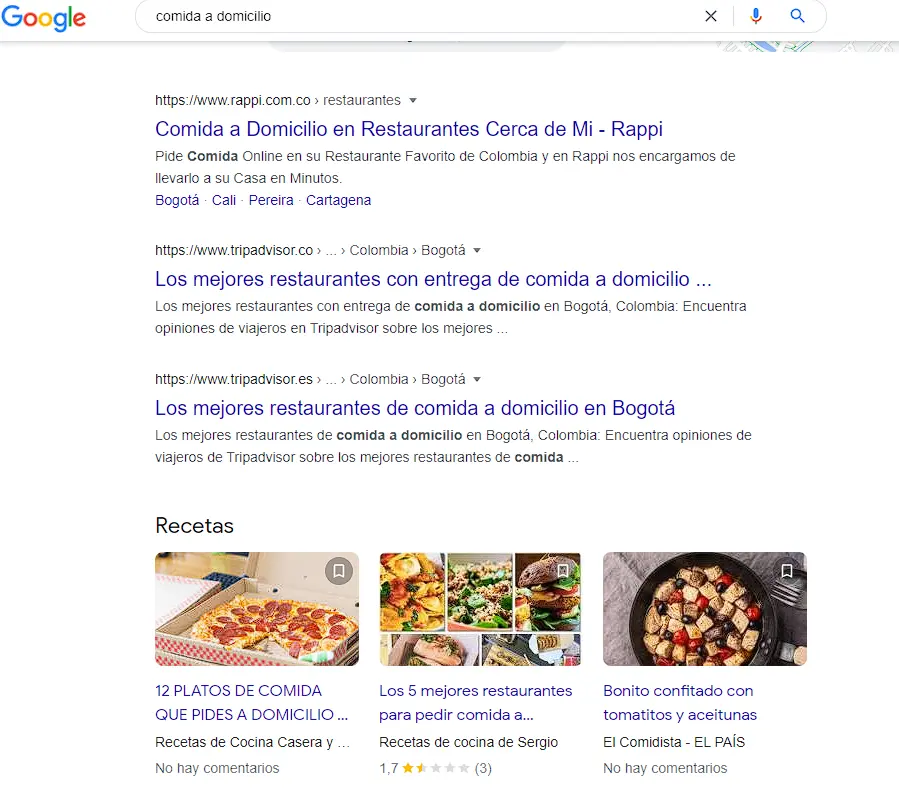
Now that you understand what happens when you search for something, let’s dig into the anatomy of that results page to see where SEO hides.
Search: the anatomy of the results
A SERP (Search Engine Results Page) is the results page you see on screen when you run any query in a search engine. This page isn’t a uniform block; it’s strategically divided to offer the best experience to the user.
Basically, there are two big worlds inside a SERP:
- Paid results (SEM / PPC): These are the ads that appear at the top or bottom with the “Sponsored” label. Brands pay for each click they receive through advertising platforms, looking for an immediate return on investment (ROI) as the main KPI.
- Organic results (SEO): These are the free results that the search engine’s algorithm decides to show because it considers them the most relevant, useful and highest quality to answer the user’s query.
| Feature | SEO (Organic) | SEM (Paid) |
|---|---|---|
| Cost per click | Free ($0) | You pay for every click (CPC) |
| Time to results | Medium to long term | Immediate once the campaign is on |
| Sustainability | Attracts steady traffic over time | Traffic stops if you stop paying |
| Placement | Below the ads and in special blocks | Priority positions with the “Sponsored” label |
| Main KPI | Rankings and organic traffic | Return on investment (ROI) |
But how does Google decide which pages go on top in the organic section and which ones fade into oblivion? It all starts with how the search engine works internally.
How search engines work
Search engines work like a gigantic library that updates every second to organize all the information on the internet. Google is, to date, the most widely used search engine in the world.
To organize all this chaos, Google sends out spiders (also called bots or robots) to crawl every corner of the web. Picture these spiders running an endless race, jumping from link to link to read the code and content of web pages. Google explains this process in its official documentation: how Google Search works.
The process is split into three fundamental phases:
- Crawling: The spiders discover new URLs or spot changes in existing ones.
- Indexing: Google processes the content, understands it and stores it in its gigantic index (its database).
- Ranking: When a user runs a query, the algorithm searches its index and sorts the results in milliseconds, showing the most relevant ones first.
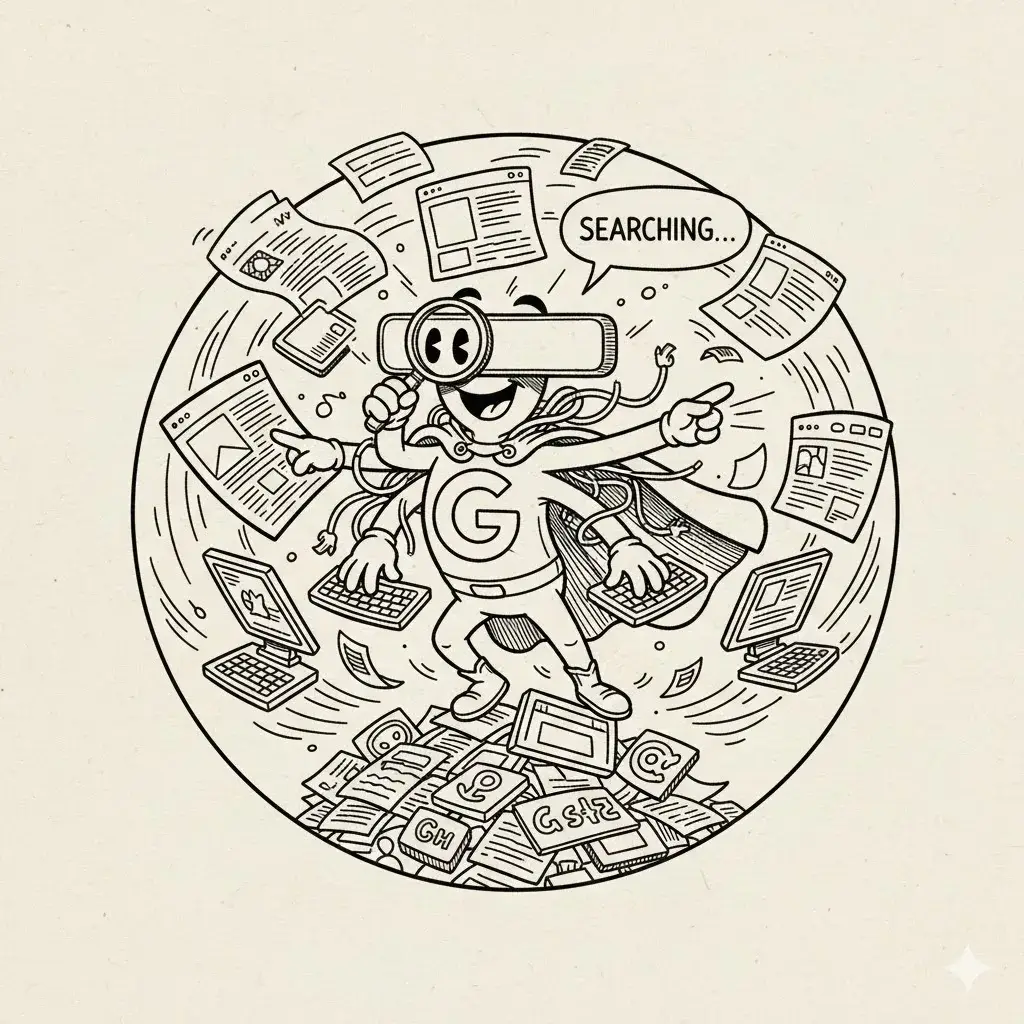
It’s vital that your website’s server doesn’t block these spiders. If you stop them from getting in, they won’t be able to read your content and your page will never exist for users.
This technical process translates into a clear three-step strategy that defines how SEO works day to day.
How does SEO work?
SEO works by making Google’s algorithms’ job easier in each of their crawling, indexing and ranking phases. Understanding that we mainly do SEO for Google, if you play in the search engine’s favor, it will reward you with better positions.
- Optimize crawling: We make sure bots discover your URLs efficiently by following clean internal links and reading your sitemap.
- Optimize indexing: We help Google understand exactly what your content is about by using clear tags, a logical structure and avoiding confusing or duplicate text.
- Optimize ranking: We offer a flawless user experience, with high-quality, useful content that loads fast, which demonstrates authority and relevance.
Even though we always talk about Google because of its absolute dominance, search engine optimization goes far beyond a single search engine.
Search engines beyond Google
Search engines go far beyond Google, because SEO applies to any platform with a search bar. Even though Google dominates the global market, there are other very powerful engines where people actively search every day:
- YouTube: It’s the second largest search engine in the world. In fact, on our YouTube channel El Joseo we teach you how to do SEO live so you can see how it works in practice. If you want to understand how it’s done, read what YouTube SEO is.
- App stores (ASO): When you search for an app in the App Store or Google Play and want to rank first, you’re doing App Store Optimization.
- Marketplaces (Amazon or MercadoLibre): Optimizing your product listings so they show up on top when someone searches “espresso machine” is pure, hard-core SEO.
- Language models (LLMs): With the arrival of ChatGPT, Claude and Gemini, the way we search is changing. Ranking now also focuses on GEO (Generative Engine Optimization) to get artificial intelligence to cite you in its answers.
With so many platforms available, it’s easy to see why SEO is one of the most coveted pieces of any business strategy.
SEO in digital marketing: profitability and conversion
SEO in digital marketing works as one of the most profitable channels out there because it responds directly to the user’s search intent. You’re not interrupting the user with an annoying ad; you’re answering a real need at the exact moment the person asks for it.

For this reason, SEO usually fights for the top 1 or top 2 channels with the highest conversion rate (whether capturing leads, calls or direct sales) in any business. It’s not like SEM, where if you didn’t put in money, they turn off the tap and you stop existing. Generally, the only channel that beats it in effectiveness is email marketing, and that’s because email works with a database of users who already know you and are highly segmented.
Besides, SEO doesn’t work alone in a cave. It’s a cross-functional role that connects with and boosts other teams:
- Development: To make sure the site loads fast and is accessible.
- Copywriting: To create useful, relevant and optimized content.
- Business strategy: To align keywords with sales goals. Here I explain why understanding your business is key for SEO.
To achieve that high conversion, the first step is working on the structure and content of your own website, which is what we call On-page SEO.
On-page SEO: your content comes first
On-page SEO is made up of all the optimizations and actions you can control directly within your own website to improve its relevance. If you ask me, this is the most important branch of SEO. In my more than 5 years of experience, I’ve seen that on-page optimizations are the ones that usually make the biggest difference in my clients’ results.
To get on Google’s podium, your content has to be the absolute king. The big initial bet should always be quality content. For content to perform and rank, you need to follow these key steps:
- Keyword research: Identify which terms and real queries your potential customers use in search engines.
- Understand search intent: Repeating keywords like a robot isn’t enough. You have to figure out what the user wants to solve (do they want to buy, to get informed, to compare?) and give them the best possible answer.
- HTML element optimization: Write attractive titles, use logical headings (H1, H2, H3) and optimize your images.
And so that this content isn’t a mess of loose pages, you need to structure it intelligently through a solid architecture.
Content organization and topic clusters
A topic cluster is a content organization strategy that groups related articles around a pillar page to build topical authority. Search engines value topical authority. If you want Google to consider you a reference on a subject, you can’t write loose articles with no connection at all.
This strategy consists of organizing your content in a hierarchical structure:
- Pillar page: A broad, complete guide that covers a general topic (for example, this guide on What is SEO).
- Supporting content (subtopics): Specific articles that go deeper into particular aspects of the main topic (for example, an article dedicated exclusively to On-page SEO or Keyword Research).
- Internal links: Connect the pillar page with the supporting articles through semantic links. This shows algorithms that you cover the topic in full and makes navigation easier for the user. Google recommends using crawlable links.
But careful: having the best text is pointless if Google can’t access it because of a technical failure on your server.
Technical SEO: the foundation of indexing
Technical SEO is the optimization of a website’s internal aspects to make sure search engines can crawl, understand and index it without problems. If On-page SEO is the decoration and products of a store, technical SEO is the foundations and plumbing of the building.
To make sure your URLs show up in Google’s index without problems, you need to master these essential technical aspects:
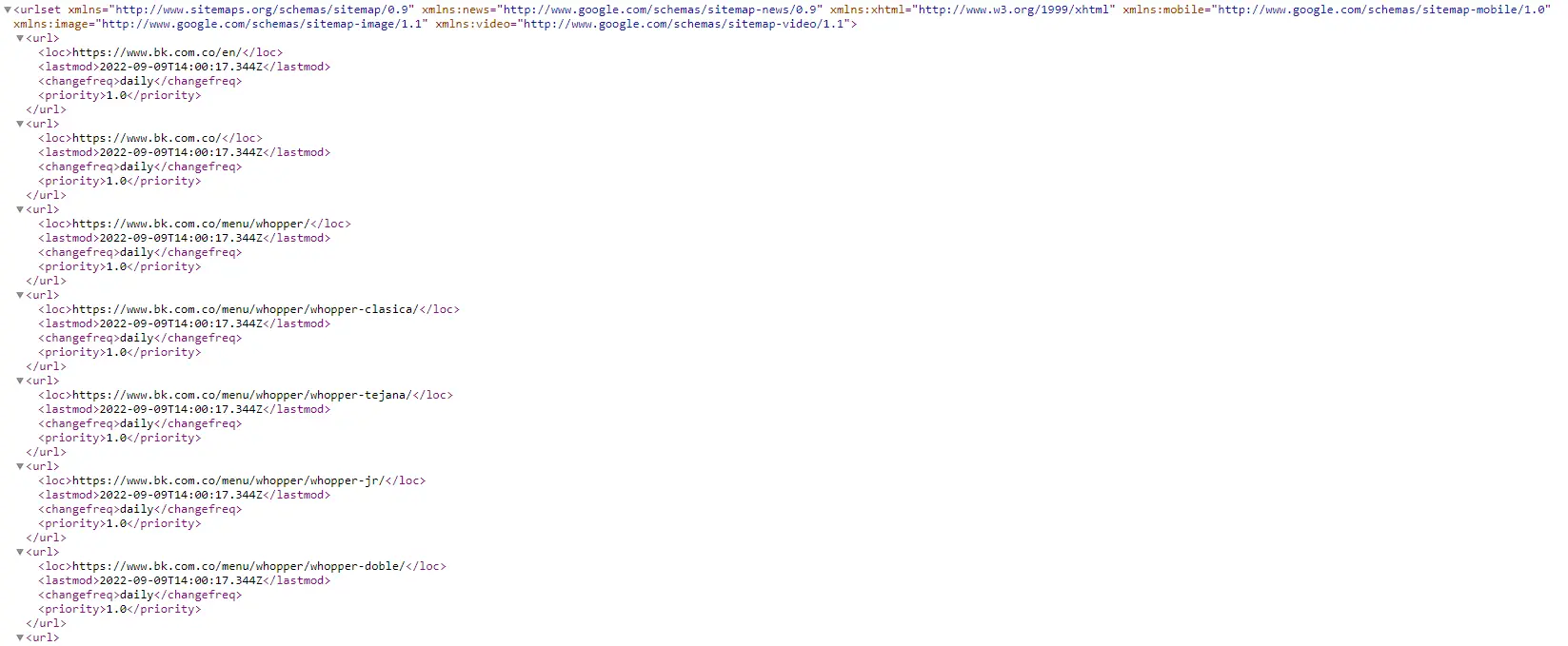
- XML sitemaps: Files that work as a map of your site, helping bots discover your most important URLs directly. Here’s what a sitemap looks like inside.
- robots.txt file: A file that manages bot crawling by telling them which parts of the site they can step on and which they can’t. Careful: it doesn’t hide pages from Google; if you want a page not to appear in the results, you need to use the
noindextag. - Canonical tags and redirects: Tools to avoid duplicate content and consolidate the strength of your links toward a single preferred URL.
- Rendering: Don’t block critical JS or CSS files. Google needs to render your page to “see” it exactly the way a flesh-and-blood user would.
In fact, this same technical SEO is the bridge that connects your website with the new era of AI-assisted search.
GEO/AEO: ranking in the age of AI
GEO (Generative Engine Optimization) is the discipline that optimizes your content so that language models (LLMs) like ChatGPT or Gemini recommend you in their answers. Today, talking about optimizing for language model recommendations is a must.
People no longer just look up basic information on Google; they now turn to ChatGPT, Claude or Gemini to solve complex transactional intents (for example: “what are the best running shoes if I supinate?”).

For these AI assistants to cite you in their answers, the key is technical SEO. LLMs consume structured data and crawl the web looking for clear, truthful, easy-to-access information. If you secure flawless technical SEO and answer users’ questions directly, you’ll be paving your way to dominate the search engines of the future. To go deeper, see how AI and SEO work together and what Google says about how your content appears in its AI features.
Once your house is in order (On-page and Technical), it’s time to look outward to gain the maximum possible authority.
Off-page SEO and link building: earning authority
Off-page SEO covers all the actions and optimizations that happen outside your own website to show Google that you’re a trusted authority. The reigning strategy here is link building, which means getting other websites to link to yours.
Google interprets these external links as “votes” of trust: if important, relevant websites in your industry link to you, it means your content is valuable.

I’ll be very honest with you: off-page is an area I don’t work on that much in my day to day, because I prefer to put all my effort into on-page and content, where I have absolute control. Getting quality links externally usually requires public relations (PR) strategies or, in many cases, money to buy placements. Careful: Google has its spam policies, which include link schemes.
My strategic recommendation is to always prioritize on-page and technical SEO. Leave link building as a resource for when you compete for extremely difficult keywords where all your rivals already have excellent content.
Besides global authority, if you have a physical business or serve a specific area, there’s a completely different game you need to master.
Local SEO: dominate your geographic area
Local SEO is the specialization of SEO focused on attracting users who search for products or services in a specific geographic location. It’s extremely important in big markets (like the United States, where I’ve done local optimization work) to dominate specific cities or states.
If a user searches “SEO consultant”, Google will show them global results; but if they search “SEO consultant in New York”, the search engine will trigger the Local Pack: a prominent map with the closest and most relevant physical businesses.
To successfully target these local queries, there are two paths you need to walk in parallel:
- Website structure (local taxonomies): Create a content cluster on your site with specific URLs for each important location (for example:
yourdomain.com/seo-consultant/new-yorkoryourdomain.com/seo-consultant/atlanta). - Google Business Profile listing: Optimize your business profile on Google (the former Google My Business). Getting reviews from real customers, adding quality photos and keeping your hours up to date is essential to appear on the map. Google explains how to improve your local ranking.
The goal of local SEO is clear: capture people with very high purchase intent in your area to generate immediate profitability.
I know all of this can sound overwhelming at first, so let’s clear up the most common doubts in one go.
Frequently asked questions about SEO
What is SEO and CEO?
SEO (Search Engine Optimization) is the set of techniques to optimize a website so it appears among the first results of search engines. A CEO (Chief Executive Officer), on the other hand, is the executive director or president of a company. They have no technical relationship with each other.
What is SEO on social media?
It consists of optimizing your profiles and posts (using keywords in captions, hashtags and bios) to appear in the internal search engines of platforms like Instagram, TikTok or LinkedIn. It lets you gain organic visibility without paying for ad campaigns.
SEO vs SEM: what are they and what’s the difference?
The main difference is that in SEO the traffic is organic and free, requiring effort and time to see results. In SEM (Search Engine Marketing) you pay the platform directly for each click through sponsored ads with the ‘Sponsored’ label on Google, looking for an immediate return on investment (ROI) as the main KPI.
What is SEO in digital marketing?
It’s the strategic channel in charge of ranking a website in search engines to attract highly qualified organic traffic. It’s considered one of the most profitable channels because it connects with users who already have an active search or purchase intent.
How do you do SEO?
It’s mainly done through three pillars: technical optimization, quality content creation and gaining external authority. First you get your site technically in shape, then you create killer texts that answer the user, and finally you get others to link to you.
Video: what is SEO
If you’d rather watch it, here I explain what SEO is and what it’s for.
Start mastering SEO today
As you’ve seen throughout this guide, SEO isn’t magic or an indecipherable secret; it’s a logical process of constant optimization. The article you just read is real, living proof that SEO works: you searched for an answer, I optimized my content to give it to you and here you are.
Throughout my career, I’ve helped projects multiply their traffic and climb Google’s podium. If you want to take the next step and learn to rank your own project, I invite you to explore all the educational content we’ve prepared for you on eljoseoweb.com. You can also subscribe to our YouTube channel, where we analyze projects and do SEO live so you can learn in a hands-on way. See you inside!
Want me to look at your case? Try the free SEO audit or book a free 30-minute consultation with me.